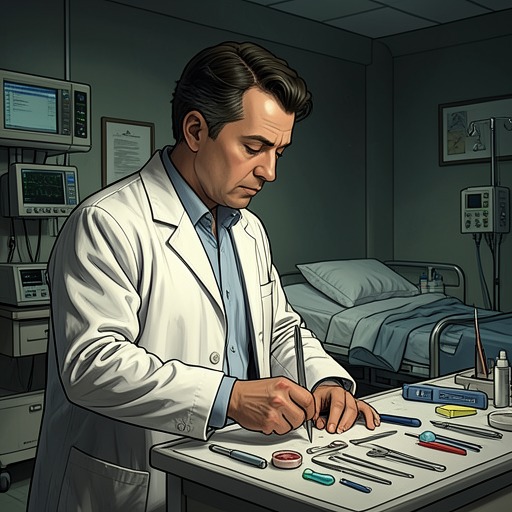
Ridgeway's Disease
The HollowRidgeway's Disease is the rare, incurable illness at the centre of John Christow's professional identity and of the novel's understanding of medical vocation. It is certain to be fatal, yet John is attempting to discover a treatment, turning the disease into both a scientific problem and a shared struggle between doctor and patient. Through Mrs. Crabtree, his prize patient at St. Christopher's Hospital, Ridgeway's Disease reveals the intensity, risk, vitality, and ethical ambiguity behind the public image of the successful Harley Street physician.
Definition and Medical Stakes
Ridgeway's Disease is described as a very rare disease from which sufferers are bound to die because no cure exists. John Christow is not merely administering routine relief: he is investigating the disease's mechanisms and trying to develop a treatment involving hormone secretion. Even John cannot explain every technical detail to Gerda Christow, and he recognizes that the condition remains imperfectly understood; doctors are not really sure why the cortex degenerates. The disease therefore represents an area where medical knowledge is incomplete, making research both intellectually compelling and clinically dangerous.
The illness also exposes the difference between treating symptoms and pursuing a cure. John spends much of his consulting-room morning prescribing palliation and alleviation for patients whose complaints offer him little to investigate. The work is financially profitable but spiritually empty to him. By contrast, Ridgeway's Disease presents a problem with obstacles to overcome, a condition that demands sustained thought, experiment, and invention. Its rarity does not make it marginal in John's mind. It gives his work the urgency of a frontier.
John Christow's Research and Fatigue
John's involvement with Ridgeway's Disease is closely tied to his physical and emotional exhaustion. While seeing patients, he can produce sympathy, encouragement, and apparent warmth almost automatically; after one patient leaves, however, he forgets her almost entirely and feels the depletion caused by having acted as a healer. His increasing tiredness has already begun to feed an irritability he cannot control. The contrast is important: ordinary medical practice drains him, whereas difficult research, although exhausting, restores his sense of purpose.
His work on the disease includes experimental calculations and uncertainty about how to reduce toxicity while maintaining the hormone content and neutralizing the pantratin. A recent setback has shaken him: Mrs. Crabtree's toxicity has risen alarmingly, and the D.L. reaction was negative instead of positive after John had believed he was following the right path. He worries that he has been too confident and has assumed that he had circumvented every difficulty. The image of the old woman lying blue and gasping for breath turns scientific error into an immediate human crisis.
Henrietta Savernake helps him recover his intellectual momentum. He talks through the setbacks, possible theories, and methods of combating the toxic symptoms for two and a half hours. Although he is scarcely conscious of her presence, her quick intelligence repeatedly advances the argument when he hesitates. By the end, his belief in himself is returning: the main theory may be correct, and he intends to have Neill combine two solutions the next morning. His declaration that he will not be beaten is followed by sleep from sheer exhaustion. Ridgeway's Disease thus produces a recurring rhythm of confidence, failure, analysis, and renewed determination.
Mrs. Crabtree as Patient and Collaborator
Mrs. Crabtree is the patient through whom the disease becomes most fully embodied. John values her above the romantic entanglements that trouble him because she is a fighter who wants to live. Her circumstances are harsh: she lives in a slum, has a drinking husband and unruly children, and works continuously scrubbing the floors of offices. Yet she possesses what John recognizes as a zest for existence. He and Mrs. Crabtree seem to understand one another because both are committed to life itself rather than to the comfort or respectability of life's circumstances.
Their relationship is unusually reciprocal for a doctor-patient relationship. John conducts experiments on her and treats her as a crucial test of his theory, but she knowingly accepts the risks because she wants to get well and believes that someone must be first. When she accuses him of making a guinea pig of her, she does so with a grin and immediately permits him to continue. She tells him that she can endure the treatment and that he may have his fun with her. Her willingness is not passive submission: it is an active decision to place her strength at the service of the attempt to defeat the disease.
Mrs. Crabtree's own language gives the treatment a collective meaning. She wants to live because long life runs in her family, and she refuses to surrender when the treatment fails to proceed according to plan. John answers her resistance with encouragement, insisting that she is tough and can take more. He tells her that the two of them are going to make medical history. The phrase transforms an isolated clinical experiment into a partnership, though it also reveals the pressure placed upon her to sustain John's ambition. She is both a person fighting for survival and the indispensable evidence on which his medical hopes depend.
Disease, Identity, and Human Attachment
For John, Ridgeway's Disease clarifies what kind of doctor he is. His work with wealthy women in Harley Street is a sideline compared with the intense scientific curiosity and possibility of achievement represented by Mrs. Crabtree and St. Christopher's Hospital. Henrietta later insists to Hercule Poirot that if John had been asked which woman occupied his mind most, he would have named Mrs. Crabtree—not because of romantic feeling, but because she belonged to the work that mattered most to him. The disease therefore corrects the misleading impression that John's life can be explained chiefly through his relationships with Gerda, Henrietta, and Veronica Cray.
The disease also explains why John can be both compassionate and controlling. He draws strength from patients who share his will to live, yet his research requires him to impose procedures, assess reactions, and decide how far an experiment should continue. Mrs. Crabtree's courage makes the arrangement feel mutual, but the danger remains real: John's calculations concern toxicity, hormone content, and the possibility that his theory is wrong. Ridgeway's Disease places his scientific curiosity beside the patient's vulnerability, refusing to separate the noble desire to cure from the power exercised in the name of cure.
After John's Death
After John dies, Ridgeway's Disease continues to shape the living. Henrietta remembers how he used to speak eagerly in his studio about the illness, his triumphs and despairs, Mrs. Crabtree, and St. Christopher's Hospital. When grief and bitterness threaten to overwhelm her, the memory gives her a direction: she decides to go to St. Christopher's. The disease thus carries John's presence beyond the scene of his death and redirects Henrietta from private mourning toward the work and patients that had defined him.
At the hospital, Mrs. Crabtree is now being treated by a young doctor with spectacles whom she finds very different from John. She remembers John's jokes, his insistence that she could endure more, and the expectation he placed upon her. When she fears that she may soon be attending her own funeral, Henrietta tells her not to let go. The treatment remains the same, but Mrs. Crabtree must now possess enough courage for both herself and the dead doctor. She agrees to do her best, accepting the burden of continuing the attempted medical history alone.
Ridgeway's Disease therefore survives John as an unfinished promise rather than a solved medical mystery. Its significance lies not in a confirmed cure but in the chain of effort it creates: John's scientific persistence, Mrs. Crabtree's defiance of fatalism, Henrietta's belated understanding, and the patient's decision to continue after the doctor's death. The illness is the clearest measure of what John loved most—the difficult, life-preserving work itself—and the means by which that vocation remains active after his life has ended.